For amateur players, selecting the right Hurricane 3 sponge is more than just a color preference—it is about matching the rubber’s physics to your blade and physical technique. Here is a definitive guide to understanding the functional differences between No. 20 and No. 22 sponges.
1. The Core Identities: No. 20 vs. No. 22
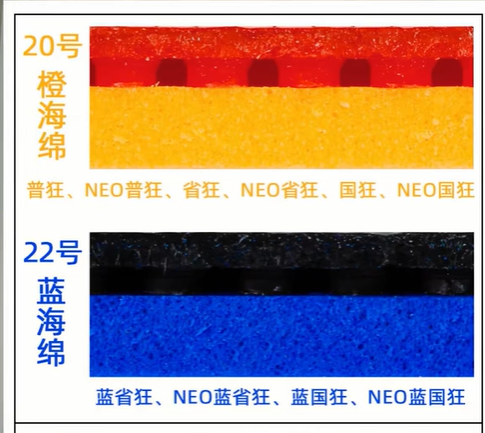
First, understand that these are two distinct sponge formulations. The Orange Sponge (typically No. 20) is designed for a “crisp” feel, while the Blue Sponge (No. 22) is engineered for higher density and tension.
- Warning: Be wary of cheap “dyed” blue sponges on the market. Genuine DHS Blue Sponge offers a unique structural resilience that dye alone cannot replicate.
2. Feel and Elasticity: “Crisp” vs. “Tough”
At the same hardness degree (e.g., 39°), the two sponges behave differently under impact:
- Orange Sponge: Offers a “crisp-elastic” (cui-tan) sensation. It has a faster initial speed off the bat and is generally easier to “bottom out” (penetrate), making it more forgiving for players with moderate power.
- Blue Sponge: Feels “tough-elastic” (ren-tan). It feels significantly firmer and requires more effort to compress, but provides a higher ceiling for energy return when fully engaged.
3. Shot Quality: Speed vs. Spin
The sponge choice dictates the trajectory and “danger” of your loop:
- Orange Trajectory: Produces a moderate, predictable arc with high initial velocity. Ideal for close-to-the-table quick attacks and flat hitting.
- Blue Trajectory: Because the Blue Sponge holds the ball longer (dwell time), it generates more intense friction. This results in a “dipping” arc that is more difficult for opponents to time, offering superior power and “floor” from the mid-to-far distance.
4. Technical Requirements: The “Double-Edged Sword”
The Blue Sponge’s superior support comes at a cost:
- The Power Tax: Without a solid technical foundation and high swing speed, the Blue Sponge will feel “dead” and exhausting to play with. Your error rate will increase because the ball won’t leave the rubber with enough depth.
- The Beginner Choice: For most amateur players or those still developing their stroke, the Orange Sponge provides better consistency and “free” speed.
5. Blade Pairing: Balancing the System
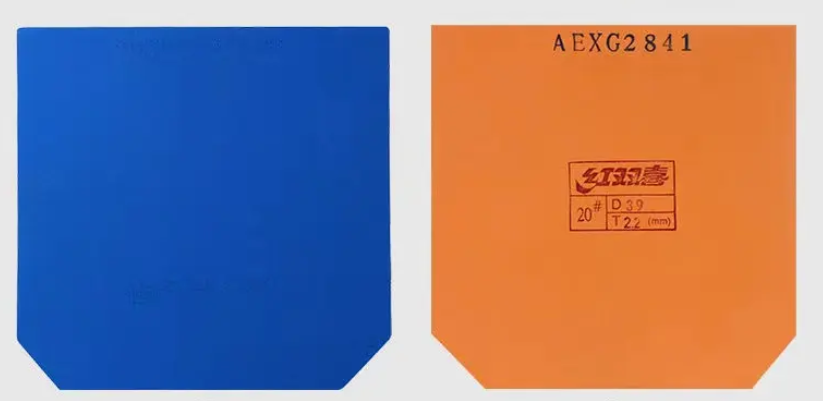
The synergy between your blade and sponge is the final piece of the puzzle:
- Soft/Flexible Blades: (e.g., Fan Zhendong ALC, Lin Gaoyuan ALC). Pair these with Orange Sponge to compensate for the blade’s lack of raw speed.
- Hard/Stiff Blades: (e.g., Super ALC series, Viscaria Super ALC). Pair these with Blue Sponge. The stiff blade provides the “kick,” while the Blue Sponge adds the necessary dwell time to ensure the ball actually spins rather than just flying off the wood.
Pro Tips for Optimization
- The “Boosting” Rule: Both sponges are designed for professional use and require “boosting” to truly unlock their potential and elasticity.
- Evolutionary Path: Start with Orange Sponge to master your form. Only transition to Blue Sponge once you find yourself consistently “bottoming out” the orange version and requiring more top-end power.