Outer vs Inner Fiber
Under ITTF rules, a blade must be at least 85% wood. The remaining materials are usually specialty fibers. The popular layout is 5+2: five wood plies plus two fiber layers. Where those fibers sit decides whether the blade is outer or inner.
- Outer fiber — fiber sits directly under the face ply
- Inner fiber — fiber sits on both sides of the core
What changes in play
| Outer fiber | Inner fiber | |
|---|---|---|
| Mid/light contact | Fiber engages early | More all-wood feel |
| Speed / spring | Usually snappier, higher rebound | More moderate until you load hard |
| Control / spin | Easier to feel “too springy” | Easier hold, spin, and arc shaping |
| Typical cores | Often kiri | Often ayous |
Outer examples lean hard into fiber character—classic outer carbon like Zhang Jike T5000 (no aramid) is very springy and, for many players, harder to tame.
Inner examples (e.g. DHS W968 with inner KLC) stay softer at mid force: more wood-like, easier control and spin—closer to how Hurricane Long 5 feels on lighter swings.
Why many top players lean inner
Plastic-ball rallies reward multi-ball control. That pushes demand toward blades you can steer: hold, spin, and arc. National-team setups often favor inner for that reason.
Even outer blades have shifted toward more dwell—gold Viscaria, Lin Gaoyuan ALC, Fan Zhendong ALC are common “hold-oriented outer” references.
Simple pick
Prefer to create spin and shape the ball yourself → start with inner.
Prefer to borrow pace and chase first-speed → consider outer.
Related blade note: Harimoto SZLC vs SALC (both inner, different fiber / thickness).
Why some inner blades still feel fast
Inner does not mean slow. At mid force it shows more wood character—and wood hardness varies a lot.
Same inner KLC, different face:
| Blade | Face | Mid-force feel |
|---|---|---|
| N301 | Koto | Firmer / faster |
| W968 | Limba | Softer / woodier |
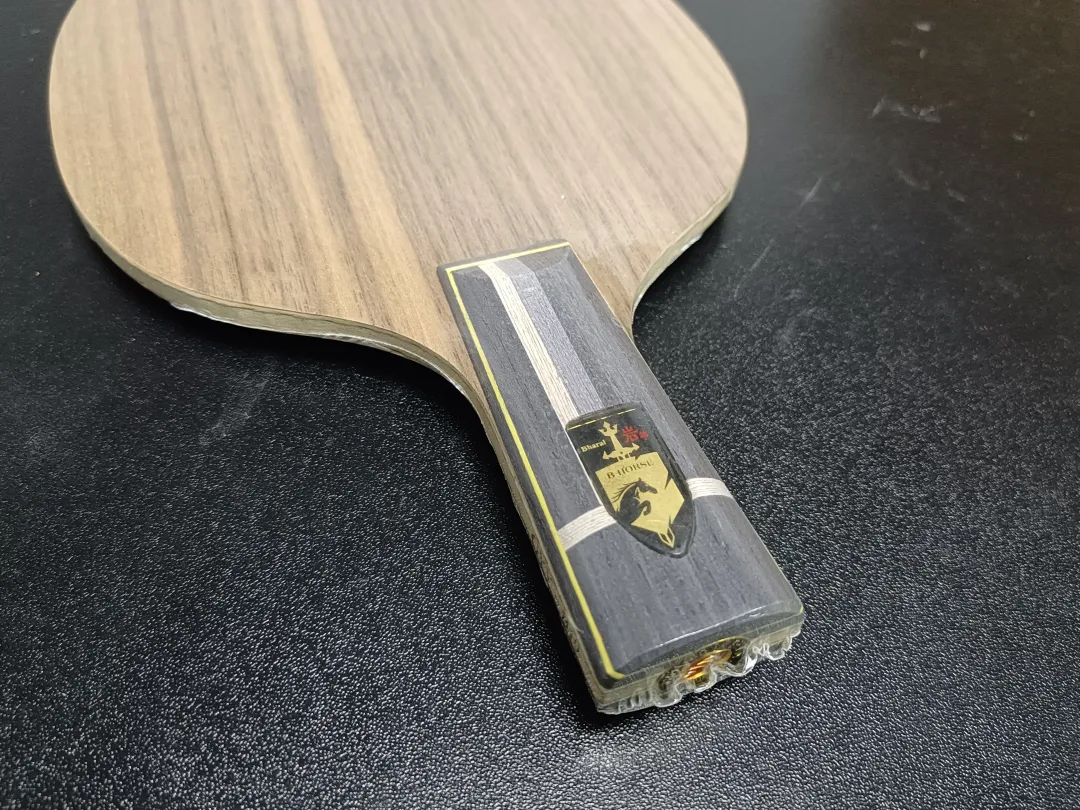
Harder faces (walnut, rosewood, ebony, bharal/岩羊, etc.) can make an inner blade block almost as quick as an outer. The difference shows more when looping:
- Hard-face inner — big deformation + ayous cores often give longer arcs and stronger behind-the-table threat
- Outer — with common kiri cores, arcs are usually shorter; better suited to near/mid-table pace games
Use your stance as a filter: fast near-table counterplay → outer is a natural fit; stepping back to load heavy loops → inner (especially with a supportive core) often helps.
Thickness still matters
Blade thickness changes stiffness and support. A thick inner blank can approach outer speed—e.g. 6.2 mm Harimoto SZLC or Ovtcharov ALC.
Factories usually balance fiber aggression with thickness. Boll ZLC was once called extremely violent: high-rebound outer ZLC would punch through immediately, so Butterfly kept the blank near ~5.5 mm so the blade could still bend and loop.
Bottom line
- Outer = fiber closer to the face → earlier spring, more first-speed.
- Inner = fiber deeper → more wood feel until you hit through; easier control/spin for many players.
- Face wood, core, and thickness can make an “inner” play fast—or an “outer” play more hold-friendly. Match the layout to how you create pace, not only to the fiber sticker.